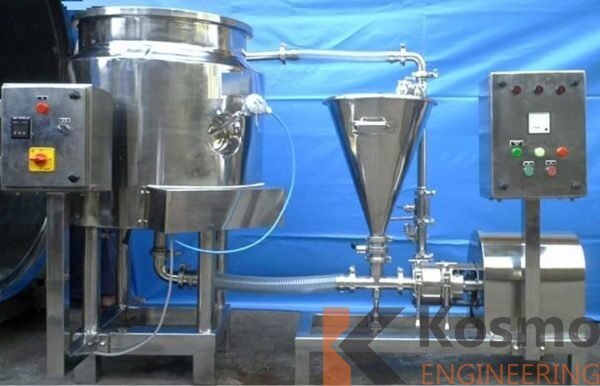
A ribbon blender is usually the better choice for free-flowing dry powders that need a thorough, uniform blend, such as spice mixes, premixes and detergent powders. A paddle mixer is the better fit for fragile ingredients, mixes with very different particle sizes or densities, and wetter or heavier batches. Both are horizontal mixers, but they move material in very different ways, and that difference decides which one suits your product.
How a Ribbon Blender Works
A ribbon blender has a U-shaped trough with a shaft carrying two helical ribbons, an outer one and an inner one. The outer ribbon pushes material towards one end of the trough while the inner ribbon pushes it back the other way. This counter-flow, together with the radial movement of the ribbons, blends powders quickly and evenly.
Ribbon blenders are the workhorse of powder mixing in food, spice, chemical and pharmaceutical plants. Kosmo’s Ribbon Blender Mixer is a typical industrial example, built in SS304 or SS316 for food use. For a fuller explanation, see our ribbon blender guide.
How a Paddle Mixer Works
A paddle mixer uses flat or angled paddles fixed to a shaft instead of continuous ribbons. As the shaft turns, the paddles lift and tumble the material, folding it over rather than pushing it along. This action is gentler on particles and handles products that don’t flow easily.
A tilting paddle mixer, like Kosmo’s Tilting Paddle Mixer, empties by tilting the whole trough. That gives fast, almost complete discharge and makes cleaning easier, which helps with sticky or moist mixes. Read more in our tilting paddle mixer overview.
Ribbon Blender vs Paddle Mixer: Comparison
| Factor | Ribbon blender | Paddle mixer |
| Mixing action | Counter-flowing ribbons; strong convective mixing | Paddles lift and fold material |
| Best for | Free-flowing dry powders | Fragile, irregular, heavier or moist products |
| Effect on particles | Some shear; can break fragile flakes or granules | Gentler |
| Different particle sizes or densities | Good | Better; less tendency to separate |
| Liquid addition | Good for small amounts of oil or liquid sprayed onto powder | Good, including wetter mixes |
| Working fill level | Needs a reasonable fill level to mix well | More tolerant of partly filled batches |
| Discharge | Bottom valve; some residue around the ribbons | Bottom valve, or full tilt on tilting models |
| Cleaning | More surfaces around the ribbons | Easier, especially on tilting models |
| Typical products | Spice blends, premixes, flour mixes, detergent and chemical powders | Coated or fragile granules, mixes with chunks, damp or sticky mixes |
Which Mixer Suits Your Product?
Spice blends and masala mixes
A ribbon blender is the usual choice. Ground spices, salt and fillers are free-flowing, and the ribbon action gives an even distribution of small ingredients, which matters for flavour consistency across every pack. If you add a small amount of oil, a spray bar above the ribbons distributes it well.
Premixes and fortified flours
A ribbon blender works well, provided the batch is filled to the right level. Very small ingredients such as vitamins are often pre-blended with a portion of the carrier before going into the main batch.
Fragile or coated products
Choose a paddle mixer. Flakes, coated granules, puffed snacks and products with visible pieces hold their shape better under the paddles’ folding action.
Damp, sticky or heavy mixes
A paddle mixer, especially a tilting one, handles these better and empties more completely. Very heavy, dough-like products need a dedicated kneading mixer such as a sigma mixer instead.
Detergent and chemical powders
Both can work. A ribbon blender is common for free-flowing powders, while a paddle mixer suits formulations with granules of very different sizes.
Sizing: Don’t Buy on Total Volume Alone
Mixer capacity is often quoted as total trough volume, but what matters is the working volume: the amount you can mix well in one batch. Ribbon blenders need to be reasonably full to mix efficiently, while very low fill levels reduce performance. Paddle mixers are more forgiving of smaller batches.
When comparing models, work out:
- Your batch weight in kg
- Your product’s bulk density (kg per litre)
- The batch volume this gives, which should sit within the mixer’s recommended working range
If your batch sizes vary a lot, for example small trial batches and full production runs, that points towards a paddle mixer.
After Mixing: Sifting and Packing
In spice and powder plants, the mixer usually sits between grinding and packing. Many plants pass the blended powder through a vibratory sifter to break up lumps and catch foreign matter before packing. Browse the complete range in our spices processing machinery category.
Frequently Asked Questions
Which mixer is gentler on fragile particles?
A paddle mixer. Its lifting and folding action causes less breakage than the shearing movement of ribbons.
Can I add oil or liquid in a ribbon blender?
Yes, small amounts of liquid can be sprayed onto the powder while it mixes. For wetter mixes, a paddle mixer usually performs better.
How long does a batch take to mix?
Mixing time depends on the product, the batch size and how uniform the blend needs to be. Test with your own product to set the right time, rather than relying on a general figure.
Which mixer is easier to clean?
A tilting paddle mixer is generally the easiest, because the trough tips fully and gives direct access. Ribbon blenders have more surfaces around the ribbons that need attention.
Can one mixer handle all my products?
If your products are all free-flowing powders, a ribbon blender often covers everything. If you also handle fragile, moist or chunky mixes, you may need a paddle mixer as well, or instead.
Get the Right Mixer for Your Batch
Kosmo Engineering manufactures ribbon blenders and paddle mixers in Karachi in mild steel and food-grade stainless steel. See the full range of ribbon blenders and powder mixers, or tell us your product and batch size and we’ll suggest the right mixer and capacity.