Use a screw conveyor for powders and small granules that need to stay enclosed, a belt conveyor for whole products, packs and inspection work along a mostly horizontal path, and a bucket elevator when free-flowing material has to be lifted straight up in a small floor space. Three questions decide the choice: what you’re moving, which direction and how high it has to go, and how clean the system must stay.
If you’re new to conveyors, start with our overview: What is a conveyor system?
The Three Questions That Decide It
1. What are you moving?
- Fine powders (flour, spice powder, milk powder, chemicals): these create dust and flow unevenly, so they’re usually moved in an enclosed screw conveyor.
- Granules and seeds (sugar, rice, pulses, peanuts): these flow freely and work with screw conveyors, bucket elevators or belts.
- Whole products (fruit, vegetables, snacks, packed goods): these need a belt or roller conveyor that carries them without crushing.
- Fragile products (puffed snacks, chips): these need gentle belt handling with minimal drops.
2. Which direction and how high?
- Horizontal or gentle slope: belt and screw conveyors both work.
- Steeper incline: a belt with cleats, or an inclined screw conveyor at reduced capacity.
- Vertical lift: a bucket elevator moves material straight up using little floor space.
3. How clean must it stay?
For food contact, choose stainless steel construction, food-grade belts, and designs that open up for cleaning. Enclosed conveyors keep dust in and contamination out. Open belts are easier to inspect and wash.
Comparison at a Glance
| Factor | Belt conveyor | Screw conveyor | Bucket elevator |
| Best materials | Whole products, packs, bulk solids | Powders, granules, small seeds | Free-flowing granules and small pieces |
| Direction | Horizontal, moderate incline | Horizontal, inclined; flexible types can curve | Vertical |
| Enclosed? | Usually open | Yes | Yes |
| Dust control | Low | High | High |
| Gentleness | High | Low to medium (some product shear) | Medium |
| Floor space | Long footprint | Compact | Very compact for its lift |
| Cleaning | Easy to reach | Needs access covers or a removable screw | Needs inspection doors |
| Typical use | Sorting, inspection, cooling, packing lines | Feeding mixers, mills and packing machines | Lifting product into silos, hoppers or upper floors |
Belt Conveyors
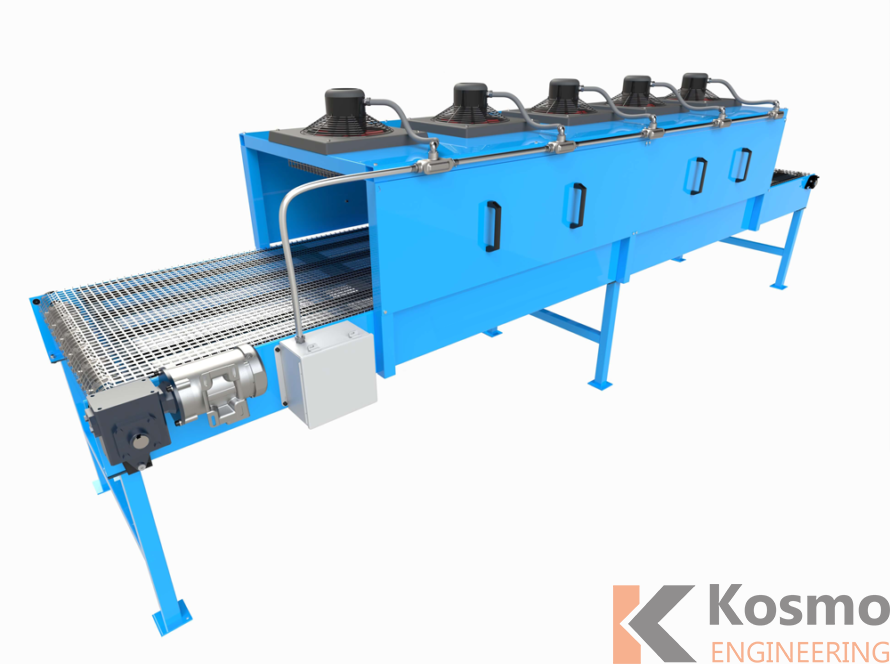
Belt conveyors are the most flexible choice for whole products and packing lines. Operators can stand alongside them for sorting and inspection, and they can be fitted for specific jobs:
- Elevator belt conveyors with cleats lift product up an incline
- Cooling conveyors carry fried or cooked product while it cools before packing
- Rubber roller and brusher roller conveyors turn and clean fruit and vegetables as they move
For food, choose a food-grade belt material and a stainless steel frame where the product or wash water touches the structure.
Screw Conveyors
A screw conveyor turns a helical flight inside a trough or tube, pushing material forward. Because it’s enclosed, it keeps powders contained and is ideal for feeding mixers, mills and packing machines at a steady rate.
- SS screw auger conveyors are rigid and suit fixed routes between machines.
- Flexible spring screw conveyors use a spiral inside a flexible tube, so the route can bend around obstacles. They’re popular for transferring powders into mixers and hoppers.
Screw conveyors can run on an incline, but capacity drops as the angle increases. They also apply some shear, so they’re not the right choice for fragile pieces. Our screw conveyor guide covers design and sizing in more detail.
Bucket Elevators
A bucket elevator uses buckets fixed to a belt or chain that scoop material at the bottom and discharge it at the top. It’s the most space-efficient way to lift free-flowing material such as grains, seeds, sugar or granules several metres up into a hopper, silo or upper-floor machine.
Bucket elevators are less suited to sticky or very fine, aerated powders, which can stick in the buckets or create dust at discharge.
Food-Grade Design Points
Whichever type you choose, these details matter in food plants:
- Stainless steel product-contact parts. SS304 suits most dry foods. SS316 is better for salty, acidic or wet environments.
- Smooth, continuous welds without gaps where products can collect.
- Easy access for cleaning: quick-release covers, removable screws and belt tensioners that release quickly.
- Sealed bearings positioned away from the product where possible.
Typical Layouts
Spice plant: flexible screw conveyor feeds whole spice into the grinder, a screw conveyor moves powder to the mixer, and another feeds the packing machine.
Snack plant: belt conveyors link the fryer to the flavouring drum, then a cooling conveyor carries product to an inspection belt before packing.
Grain or feed unit: a bucket elevator lifts grain into a storage hopper, and screw conveyors feed the hammer mill and mixer.
Frequently Asked Questions
Which conveyor is best for powders?
An enclosed screw conveyor, either rigid or flexible, is usually best. It contains dust and feeds powder at a controlled rate into mixers and packing machines.
Can a screw conveyor move material uphill?
Yes, but capacity falls as the incline increases. For steep or vertical lifts, a bucket elevator is usually more efficient.
When should I use a bucket elevator instead of an inclined belt?
When you need to lift free-flowing material a significant height in limited floor space. An inclined belt needs a long run to gain the same height.
What makes a conveyor food grade?
Food-safe contact materials (stainless steel and food-grade belts), smooth welds, no hidden gaps where product collects, and a design that can be opened and cleaned easily.
Need a Conveyor for Your Line?
Kosmo Engineering designs and builds belt, screw, roller and bucket conveyors in Karachi for food, spice, snack and industrial plants. Browse our conveyor range, or send us your layout and required capacity for a conveyor proposal.